

window.dataLayer = window.dataLayer || []; function gtag(){dataLayer.push(arguments);} gtag('js', new Date()); gtag('config', 'UA-165322976-1');
25 Jun 2026

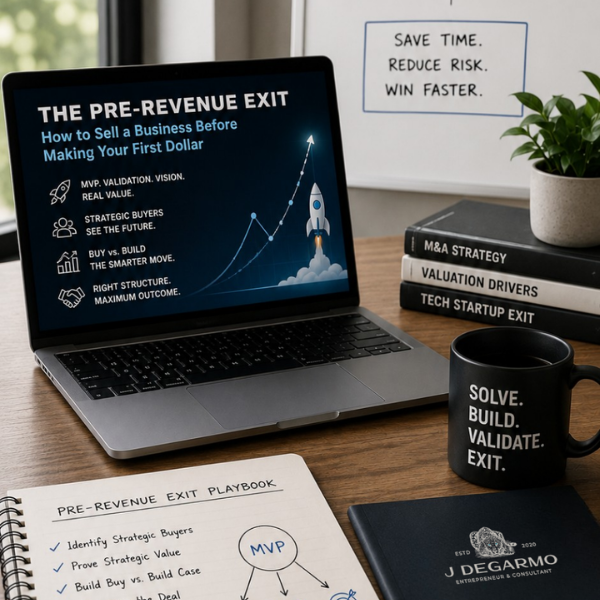
How to Sell a Business Before Making Your First Dollar

By |2026-05-29T19:53:45+00:00June 25th, 2026|Categories: Selling a Business, Starting a Business|Tags: , , , |

How to Sell a Business Before Making Your First Dollar

When most founders think about selling a company, they picture handing over years of clean profit-and-loss statements, growing EBITDA charts, and predictable cash flow models. But what happens if you’ve built an incredible asset—like a proprietary software platform, a breakthrough technology, or an advanced infrastructure—that hasn’t hit the monetization phase yet?

Selling a pre-revenue business with only a Minimum Viable Product (MVP) is completely achievable, but it requires an entirely different playbook. In this scenario, you are not selling historical financial performance; you are selling a vision, a world-class team, and massive future potential. To succeed, you must move away from public listings and focus on finding a strategic acquirer who values speed-to-market over immediate profitability.

Identify the Right Strategic Buyer Type

Because your company lacks traditional cash flow, financial buyers like standard private equity firms are rarely a good fit. They want to buy a cash-flow machine, whereas you are selling a growth engine. Instead, focus your efforts on three distinct buyer groups:

  • Strategic Acquirers (Competitors or Adjacent Firms): These are established companies that can immediately integrate your MVP to enhance their existing product lines or reach a new market faster than building it themselves.
  • Larger Competitors: Companies that view your product as an immediate threat or a defensive, necessary upgrade to their own legacy technology.
  • “Acqui-hiring” Entities: Organizations that care less about your current business model and more about securing your brilliant engineering team and core code base.

Focus heavily on Strategic Value Drivers

To justify your valuation without revenue, you must build a bulletproof case around your alternative assets. Buyers look at specific value drivers to determine what your company is worth:

  • IP and Technology: Is your MVP proprietary, patented, or technically complex to replicate?
  • Team Quality: Does your team possess specialized expertise, unique AI capabilities, or a proven track record of execution?
  • Market Need Validation: Even without sales, do you have user data, active beta testers, waitlists, pilot program results, or signed Letters of Intent (LOIs) from prospective clients?
  • Speed to Market: Prove that buying your asset saves the acquirer 12 to 24 months of costly engineering and design cycles.

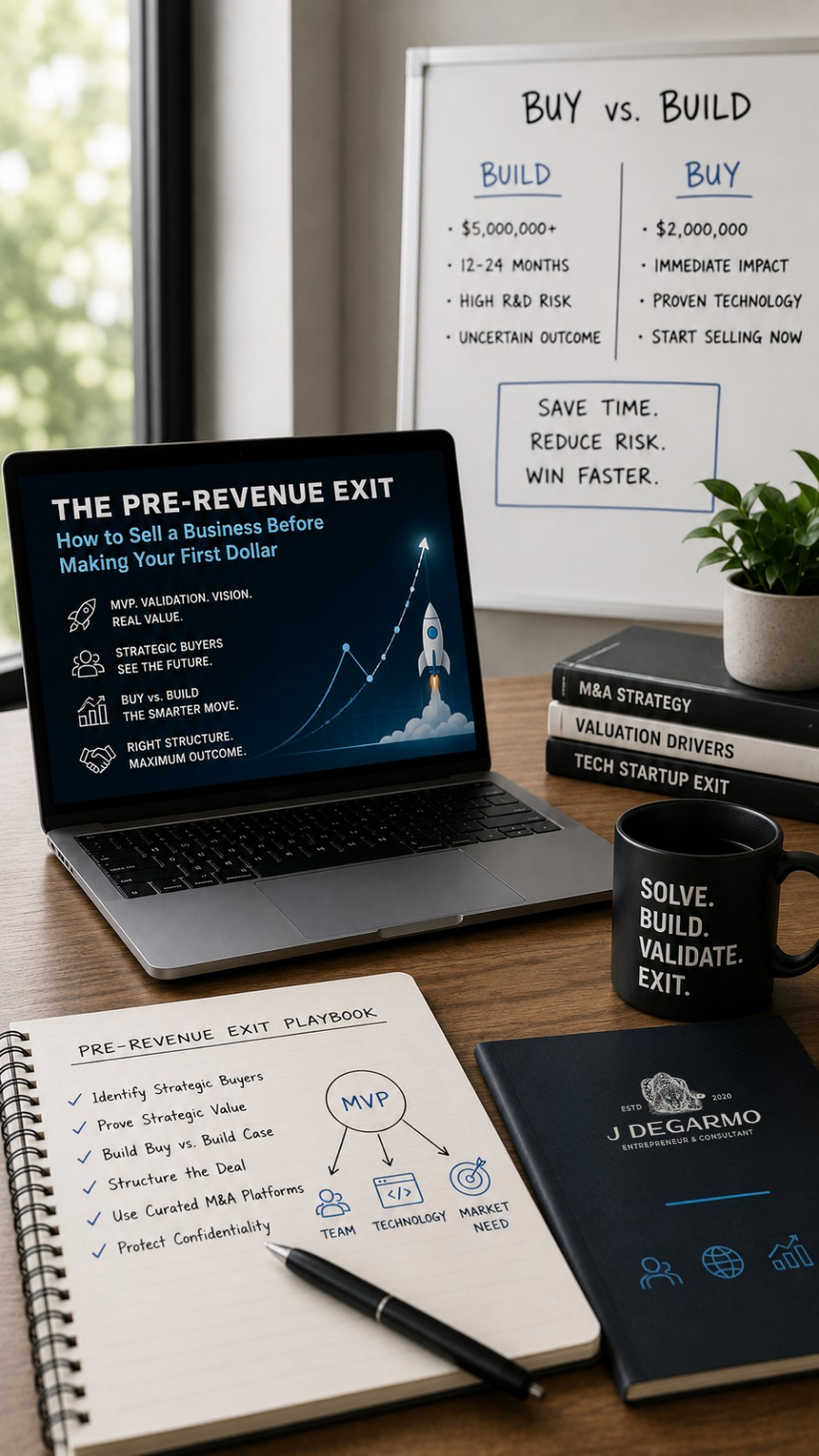
Frame the Ultimate Pitch: “Buy vs. Build”

When positioning your narrative, your entire pitch should center on a simple, defensible mathematical argument. You want the buyer’s executive team to look at their internal engineering roadmap and make a logical choice.

Your narrative should sound like this: “It will cost your corporation $5 million and 18 months of development time to build this technology from scratch. Buy us for $2 million today, bypass the R&D risk, and start selling to your customer base tomorrow.”

Adopt a Creative Transaction Structure

Pre-revenue M&A deals rarely involve a 100% cash payout upfront at the closing table. Because the buyer is absorbing significant commercial risk, expect a structure that shares that future upside:

  • Earn-outs: A major portion of your sale price will be tied to future revenue targets or specific technical development milestones post-acquisition.
  • Stock-for-Stock Exchanges: You receive equity shares in the acquiring company, allowing you to directly benefit from the future value your MVP creates under their massive distribution umbrella.
  • Acqui-hire Structures: A smaller baseline valuation for the software itself, coupled with heavy, multi-year retention bonuses and stock options for your core engineering team.

Leverage Specialized, Curated M&A Methods

The current M&A landscape is highly competitive, with substantial demand for well-prepared, high-quality tech assets. However, a pre-market or pre-revenue asset should never be posted on a public marketplace. Public listings destroy confidentiality and diminish your perceived value.

Instead, use a curated, high-touch M&A advisor or a confidential private platform that prioritizes professional buyer vetting. The leading platforms for these specialized transactions include:

  • Axial: The gold standard for the lower middle market. It offers strictly confidential deal marketing, allowing you to retain full control over who sees your MVP while matching you with pre-vetted corporate buyers.
  • Acquire.com: A highly specialized marketplace tailored directly for tech startups and SaaS businesses, designed to facilitate accelerated, private buyer-seller communication.
  • Grata Deal Network: An AI-driven search ecosystem that surfaces private companies and connects them directly with highly targeted, curated networks of corporate development professionals.
  • Aligned IQ: A confidential, seller-centric platform that utilizes a low-risk, pay-for-results model, keeping upfront costs low while prioritizing an exact strategic fit.

So, what is the right choice?

Do not assume your tech startup is valueless just because the corporate bank account hasn’t seen revenue. If you have solved a difficult technical problem and validated market interest, your speed-to-market advantage is incredibly valuable to the right corporation.

Are you holding a high-potential, pre-revenue MVP and wondering how to package it for an exit? I can help you define your strategic value drivers, build your buy-vs-build narrative, and introduce you to confidential M&A networks. Contact me today for a private, confidential review of your opportunity.

How to Sell a Business Before Making Your First Dollar
11 Jun 2026

The Earnout Blueprint: Bridging the Valuation Gap Without Losing Your Mind

By |2026-05-20T17:43:27+00:00June 11th, 2026|Categories: Selling a Business|Tags: , , , |

The Earnout Blueprint: Bridging the Valuation Gap Without Losing Your Mind

You’ve built a successful business, but the market is giving you a “wait and see” vibe. Perhaps your revenue is spiking, or you have a major contract renewal on the horizon. The buyer is interested, but they aren’t ready to pay your full price today. To solve this, many professional buyers propose a business earnout structure.

In modern M&A, earnouts help bridge the “valuation gap.” But beware: industry data from KPMG shows that in larger deals, less than 15% of earnouts pay out in full. If you want a successful exit, you need a strategy that moves beyond hope and into hard data.

Why a Business Earnout Structure Might Fail

The “devil is in the details” when it comes to legal language. Most disputes arise because the metrics used to measure success are easily manipulated.

The EBITDA Trap Buyers often propose a business earnout structure based on EBITDA. This is dangerous for you. Once the buyer takes over, they control the checkbook. They can “sink” your EBITDA by investing heavily in new marketing or hiring expensive staff, effectively wiping out your payout.

The Revenue vs. Gross Profit Solution Revenue-based earnouts are harder to manipulate but can lead to “bad growth” where you chase low-margin work. The “Goldilocks” solution is often a Gross Profit-based business earnout structure. It aligns your interests with the buyer’s by focusing on profitable growth without the accounting headaches of EBITDA.

The “Guardrail” Strategy for Your Business Earnout Structure

To protect your exit strategy, you should avoid “all-or-nothing” deals. Instead, use “guardrails” within your agreement.

  • The Floor: A minimum performance level below which no earnout is paid.
  • The Cap: A maximum payout that protects the buyer’s upside.
  • Pro-Rata Payments: Ensure you get paid for partial success. If you hit 90% of your target, you should receive a significant portion of the payout, not zero.

SBA Loans and the Business Earnout Structure

If your buyer uses an SBA loan, be careful: The SBA does not allow a traditional business earnout structure. To get around this, savvy brokers use “forgivable promissory notes” or “reverse earnouts.” In this structure, the purchase price is set at the maximum amount. If the business fails to hit targets, a portion of the seller note is “clawed back.” This achieves the same risk-sharing goal while staying compliant with federal rules.

When to Walk Away from the Deal

A business earnout structure isn’t a magic wand. You should avoid these setups if:

  1. You need full cash at closing for your next move.
  2. You are leaving the business immediately (earnouts work best when you stay to drive results).
  3. Your books are messy and cannot be measured accurately.

So, what is the right choice? A simple deal structure is almost always better than a complex one. Complexity should only solve a specific problem, not satisfy a buyer’s desire to feel “sophisticated.”

Are you facing a valuation gap that feels impossible to bridge? I can help you evaluate your buyer’s earnout proposal and ensure the “guardrails” are in your favor. Contact me today for a confidential review of your LOI.

The Earnout Blueprint: Bridging the Valuation Gap Without Losing Your Mind
4 Jun 2026

Business Valuation Multiples: Why Some Companies Sell for 10x

By |2026-05-20T16:56:27+00:00June 4th, 2026|Categories: Scaling a Business, Selling a Business|Tags: , , , |

Business Valuation Multiples: Why Some Companies Sell for 10x

A massive “Great Separation” is currently happening in the M&A market. Some owners are retiring with 10x EBITDA multiples, while others struggle to find a single buyer. This gap has nothing to do with luck. It depends on specific “value drivers” that sophisticated buyers prioritize today. If you want a premium business valuation, you must build for transferability, not just profit.

The “Owner Trap” and Your Business Valuation

The biggest killer of a high business valuation is owner dependency. If the business stops functioning when you take a vacation, it is an “expensive job,” not an asset.

Buyers seek a “turnkey” engine. They want to see:

  • A strong middle-management team.
  • Documented Standard Operating Procedures (SOPs).
  • A diversified client base where no single customer represents over 15% of revenue.

If you are the “face” of the company, a buyer sees high risk. Reducing your personal involvement immediately increases your multiple.

The Power of Recurring Revenue

Strategic buyers in 2026 pay a massive premium for predictable income. Transactional businesses—where you start at $0 every month—face lower multiples.

To maximize your business valuation, you should pivot toward:

  • Subscription models or long-term service contracts.
  • Retainer-based consulting.
  • Proprietary products that require ongoing maintenance.

Predictability de-risks the acquisition. When a buyer can forecast next year’s cash flow with 90% accuracy, they will pay more to own that certainty.

Financial Transparency and “Clean” Books

You cannot achieve a 10x multiple with “creative” accounting. Buyers and their lenders perform intense due diligence. They look for “Quality of Earnings” (QofE) reports that prove your profit is real and sustainable.

Clean financials show that you run a professional operation. Messy books lead to “re-trading,” where a buyer lowers the price at the last minute. High-value exits require audited or reviewed financial statements from the last three years.

Scalability in a Tech-Driven Market

Finally, your business valuation depends on your ability to scale. Buyers ask: “If I double the marketing budget, can the operations handle the growth?”

Companies with high-profit margins and automated workflows are easier to scale. If your business requires linear hiring for every new dollar of revenue, your multiple will stay low. Tech-enabled businesses that decouple labor from growth are the ones hitting the 10x mark.

So, what is the right choice?

You must choose which side of the “Great Separation” you want to be on. Building a sellable asset takes time, but the financial reward is life-changing.

Are you curious about where your company sits on the valuation spectrum? I can help you identify the specific “value killers” in your business before you go to market. Reach out today for a confidential assessment to ensure you exit at the top of the curve.

Business Valuation Multiples: Why Some Companies Sell for 10x
28 May 2026

The ROI Metrics Every CEO Must Know

By |2026-05-20T17:37:31+00:00May 28th, 2026|Categories: Scaling a Business, Starting a Business|Tags: , , , , |

The ROI Metrics Every CEO Must Know

If you asked a potential buyer what your business is worth today, they wouldn’t just look at your equipment or your current revenue. They would look at your “Growth Engine.” Is your marketing a predictable machine that generates profit, or is it a gamble?

To prove marketing ROI for business growth, you need to move beyond “likes” and “clicks” and focus on the math of scaling. Whether you are working with a business coach to grow your team or a business broker to prepare for an exit, these two metrics determine your company’s true health.

1. Customer Acquisition Cost (CAC): What Does a Customer Cost?

Your Customer Acquisition Cost (CAC) is the total price tag required to bring one new customer through your door. This isn’t just your ad spend; it includes sales salaries, commissions, software, and agency fees.

The Formula:

CAC = (Total Sales + Marketing Costs) / Number of New Customers Acquired

For example, if you spend $60,000 in a quarter on marketing and sales and acquire 120 customers, your CAC is $500. If you don’t know this number, you cannot safely scale your business.

2. Customer Lifetime Value (LTV): What is a Customer Worth?

While CAC tells you what you spent, Customer Lifetime Value (LTV) tells you what you gained. LTV represents the total gross profit you expect to earn from a customer over the entire duration of your relationship.

The Formula:

LTV = Average Purchase Value x Purchase Frequency x Customer Lifespan

If a customer spends $1,000 per year and stays with you for 5 years, their LTV is $5,000. Marketing ROI for business growth happens when the gap between what you pay (CAC) and what you get (LTV) is wide.

3. The “Golden Ratio”: Is Your Growth Healthy?

In the world of professional coaching and high-level M&A, we look for the 3:1 Ratio. This means your LTV should be at least three times higher than your CAC.

  • Below 3:1: You are spending too much to get customers. You might be growing, but you are likely losing money long-term.
  • Above 3:1: You have a healthy, sustainable engine.
  • Higher than 5:1: You are likely under-investing. You could be growing much faster if you spent more on acquisition.

Why This Matters for Your Exit Strategy

When a business broker prepares your company for sale, they use these numbers to justify a higher multiplier. A business with a proven 4:1 LTV-to-CAC ratio is a “turnkey” investment. It proves to a buyer that if they inject $1M into the business, they will predictably generate $4M in value.

So, what is the right choice?

Stop looking at your marketing budget as a drain on your cash flow. Start treating it as the primary lever for your marketing ROI for business growth.

Are you unsure if your marketing spend is actually building equity in your business? I can help you audit your CAC and LTV to ensure you are scaling efficiently. Contact me today for a strategy session to turn your marketing expense into a high-value investment.

Why Your Equipment Needs a Professional Appraisal
Go to Top