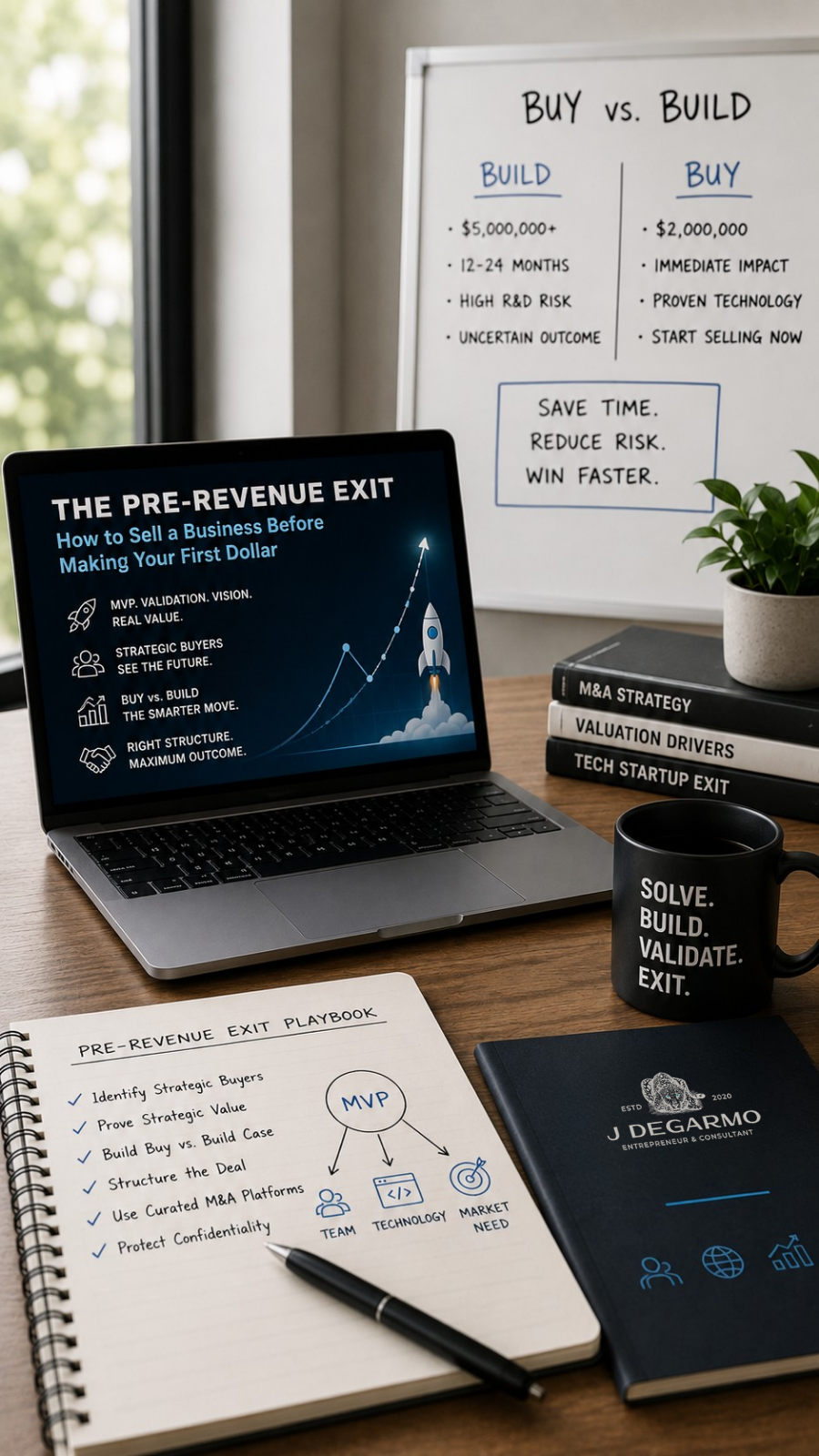

How to Sell a Business Before Making Your First Dollar
When most founders think about selling a company, they picture handing over years of clean profit-and-loss statements, growing EBITDA charts, and predictable cash flow models. But what happens if you’ve built an incredible asset—like a proprietary software platform, a breakthrough technology, or an advanced infrastructure—that hasn’t hit the monetization phase yet?
Selling a pre-revenue business with only a Minimum Viable Product (MVP) is completely achievable, but it requires an entirely different playbook. In this scenario, you are not selling historical financial performance; you are selling a vision, a world-class team, and massive future potential. To succeed, you must move away from public listings and focus on finding a strategic acquirer who values speed-to-market over immediate profitability.
Identify the Right Strategic Buyer Type
Because your company lacks traditional cash flow, financial buyers like standard private equity firms are rarely a good fit. They want to buy a cash-flow machine, whereas you are selling a growth engine. Instead, focus your efforts on three distinct buyer groups:
- Strategic Acquirers (Competitors or Adjacent Firms): These are established companies that can immediately integrate your MVP to enhance their existing product lines or reach a new market faster than building it themselves.
- Larger Competitors: Companies that view your product as an immediate threat or a defensive, necessary upgrade to their own legacy technology.
- “Acqui-hiring” Entities: Organizations that care less about your current business model and more about securing your brilliant engineering team and core code base.
Focus heavily on Strategic Value Drivers
To justify your valuation without revenue, you must build a bulletproof case around your alternative assets. Buyers look at specific value drivers to determine what your company is worth:
- IP and Technology: Is your MVP proprietary, patented, or technically complex to replicate?
- Team Quality: Does your team possess specialized expertise, unique AI capabilities, or a proven track record of execution?
- Market Need Validation: Even without sales, do you have user data, active beta testers, waitlists, pilot program results, or signed Letters of Intent (LOIs) from prospective clients?
- Speed to Market: Prove that buying your asset saves the acquirer 12 to 24 months of costly engineering and design cycles.
Frame the Ultimate Pitch: “Buy vs. Build”
When positioning your narrative, your entire pitch should center on a simple, defensible mathematical argument. You want the buyer’s executive team to look at their internal engineering roadmap and make a logical choice.
Your narrative should sound like this: “It will cost your corporation $5 million and 18 months of development time to build this technology from scratch. Buy us for $2 million today, bypass the R&D risk, and start selling to your customer base tomorrow.”
Adopt a Creative Transaction Structure
Pre-revenue M&A deals rarely involve a 100% cash payout upfront at the closing table. Because the buyer is absorbing significant commercial risk, expect a structure that shares that future upside:
- Earn-outs: A major portion of your sale price will be tied to future revenue targets or specific technical development milestones post-acquisition.
- Stock-for-Stock Exchanges: You receive equity shares in the acquiring company, allowing you to directly benefit from the future value your MVP creates under their massive distribution umbrella.
- Acqui-hire Structures: A smaller baseline valuation for the software itself, coupled with heavy, multi-year retention bonuses and stock options for your core engineering team.
Leverage Specialized, Curated M&A Methods
The current M&A landscape is highly competitive, with substantial demand for well-prepared, high-quality tech assets. However, a pre-market or pre-revenue asset should never be posted on a public marketplace. Public listings destroy confidentiality and diminish your perceived value.
Instead, use a curated, high-touch M&A advisor or a confidential private platform that prioritizes professional buyer vetting. The leading platforms for these specialized transactions include:
- Axial: The gold standard for the lower middle market. It offers strictly confidential deal marketing, allowing you to retain full control over who sees your MVP while matching you with pre-vetted corporate buyers.
- Acquire.com: A highly specialized marketplace tailored directly for tech startups and SaaS businesses, designed to facilitate accelerated, private buyer-seller communication.
- Grata Deal Network: An AI-driven search ecosystem that surfaces private companies and connects them directly with highly targeted, curated networks of corporate development professionals.
- Aligned IQ: A confidential, seller-centric platform that utilizes a low-risk, pay-for-results model, keeping upfront costs low while prioritizing an exact strategic fit.
So, what is the right choice?
Do not assume your tech startup is valueless just because the corporate bank account hasn’t seen revenue. If you have solved a difficult technical problem and validated market interest, your speed-to-market advantage is incredibly valuable to the right corporation.
Are you holding a high-potential, pre-revenue MVP and wondering how to package it for an exit? I can help you define your strategic value drivers, build your buy-vs-build narrative, and introduce you to confidential M&A networks. Contact me today for a private, confidential review of your opportunity.